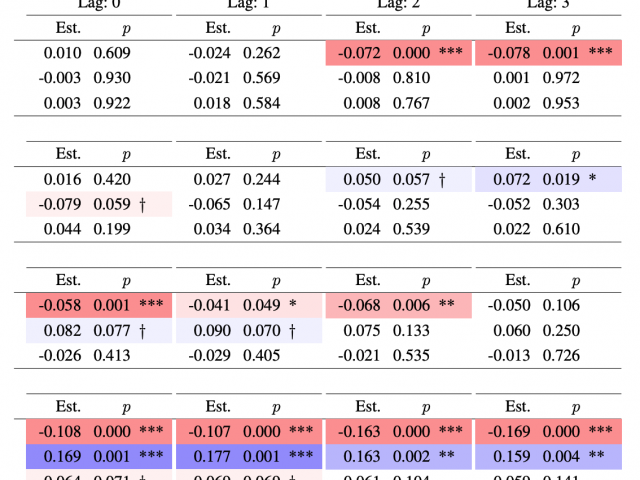
Social categories serve as key anchors for organizations and groups, helping to establish their identities and positions within conceptual spaces such as market and cultural niches. Researchers have examined the social categorization of both online communities and offline organizations through tags, folksonomies, and news outlets. While these studies have provided valuable insights into the success of online communities and formal organizations, the relationship between social categories and the organizational processes of hyperlocal groups remains unclear. Hyperlocal groups typically form and interact online through event-based social networks (EBSNs) while their activities take place offline. As a result, the structures of competition and individuals’ participation patterns may differ from those of online communities and formal organizations. This paper examines how ecological features, such as legitimation, competition, and category fuzziness, shape group membership and participation on an EBSN. Based on a retrospective analysis of 2017 Meetup data, a widely used EBSN platform, this study applies and extends organizational ecology theory to offer new insights into the ecological dynamics of hyperlocal groups in major U.S. cities.
*This project was supported by resources provided by the Office of Research Computing at George Mason University (URL: https://orc.gmu.edu, NSF #2018631) and funded in part by grants from the National Science Foundation (Award #2217706).
*Myeong Lee is the corresponding author.